
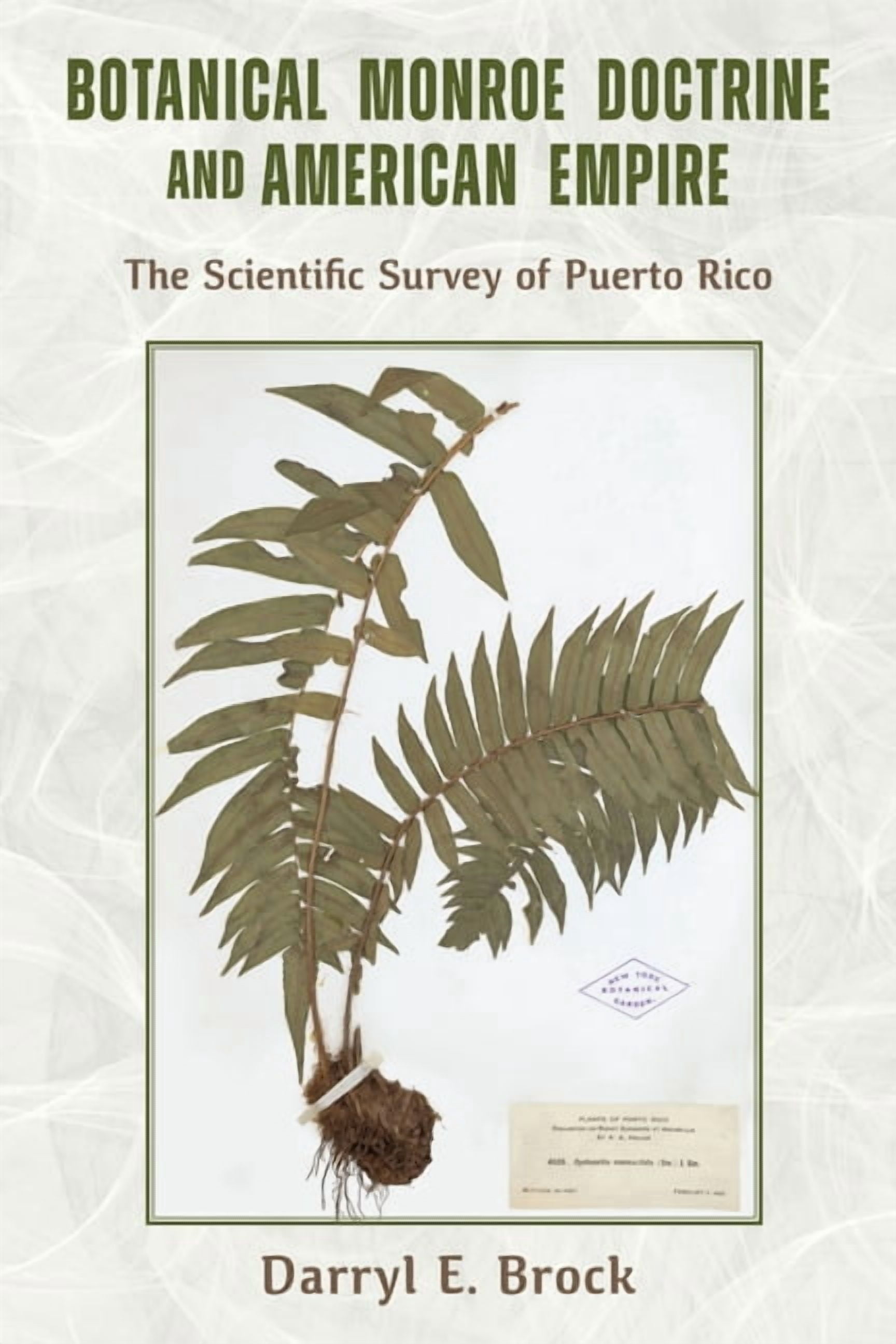
Nexus: New Histories of Science, Technol Botanical Monroe Doctrine and American Empire: The Scientific Survey of Puerto Rico, (Paperback)
Product details
| Management number | 240317097 | Release Date | 2026/07/16 | List Price | US$15.98 | Model Number | 240317097 | ||
|---|---|---|---|---|---|---|---|---|---|
| Category | |||||||||
<p><i><b>Explores how a US-led natural history survey of Puerto Rico served American Empire while yet catalyzing Boricua cultural nationalism</b></i></p><p>In<i> Botanical Monroe Doctrine and American Empire</i>, Darryl E. Brock interrogates the history, trajectory, and influence of an ambitious initiative to conduct a "physical and natural history survey of Porto [Puerto] Rico." As founder of The New York Botanical Garden, Nathaniel Lord Britton's formulation of a botanical Monroe Doctrine, reinforced by the 1912 survey proposal, served to check British and European botanical interests in the Americas. That is, <i>American</i> scientists would name <i>American</i> species according to <i>American</i> codes. Evolutionary theory would inform these taxonomic imperatives. Yet, while initially aligned with the "civilizing" mission, Britton's Scientific Survey of Puerto Rico would ultimately contribute to insular modernization as well as technocratic professionalization. The survey's foundational Taíno archaeological and jíbaro folkloric contributions would make possible today's Caguana Indigenous Ceremonial Park and indirectly advance Boricua cultural nationalism. Moreover, the overlap of scientific production with political economy affected outcomes as diverse as bilingual education in Puerto Rico and management of President Franklin D. Roosevelt's New Deal program on the island.</p><p>The New York Academy of Sciences sponsored the Scientific Survey of Puerto Rico with the final report issued in 1970. The New York Botanical Garden conducted the research in concert with the American Museum of Natural History and the Yale Peabody Museum. Over the course of the project, Puerto Rican intellectuals and scientists endorsed and even contributed to the survey. These included Cornell-trained mycologist Carlos Chardón who later served as the University of Puerto Rico's chancellor. Beyond natural history, the survey's geological commitment led to its leadership advancing insular economic development via the governor's Committee on Mineral Resources. Operations soon expanded to include the Virgin Islands and comprised nearly two dozen field expeditions. Botany alone achieved collection of ten thousand plant specimens with thirty-eight new species discovered. The nineteen published survey volumes boast some of the most complete multidisciplinary scientific descriptions of any tropical area. Brock's groundbreaking contribution is a must-read for those interested in the history of science (including forestry and geology), Puerto Rico, and US imperialism.<br> </p>
- Nexus: New Histories of Science, Technol Botanical Monroe Doctrine and American Empire: The Scientific Survey of Puerto Rico, (Paperback)
- Author: Darryl E Brock
- ISBN: 9780817362881
- Format: Paperback
- Publication Date: 2027-01-31
- Page Count: 344
| Book format | Paperback |
|---|---|
| Fiction/nonfiction | Non-Fiction |
| Genre | Textbooks |
| Publication date | January, 2027 |
| Pages | 344 |
| Subgenre | History |
| Series title | Nexus: New Histories of Science, Technology, the Environment, Agriculture, and Medicine |
| Number in series | 0 |
| Edition | 1 |
| Publisher | University of Alabama Press |
| Original languages | English |
| Language | English |
| Edu focus | Science & Technology |
| Educational level | General |
| Is collectible | N |
| Recording time | 0 min |
| Retail packaging | Single Piece |
| Assembled product dimensions (l x w x h) | 6.00 x 6.00 x 9.00 in |
| Assembled product weight | 1 lb |
| Bisac subject heading | Science |
Bestseller ranking
Expeditions & Discoveries History Books






Customers who viewed this product also viewed
Earmuffs


Correction of product information
If you notice any omissions or errors in the product information on this page, please use the correction request form below.
Correction Request Form